Reliable data security for SMEs
Cyberattacks, insecure remote access, and outdated networks are no longer new topics for small and medium-sized enterprises. Most companies are now aware that their IT infrastructure needs modernization. At the same time, requirements are increasing due to cloud applications, mobile work, and connected production environments. However, between staff shortages, daily operations, and ongoing projects, modernization of IT infrastructure is often postponed – even though the pressure regarding IT security, data protection, and digitalization continues to grow.
The underlying questions are usually pragmatic: How do we protect ourselves against ransomware? How can we securely integrate cloud applications and smart industry solutions? And how can IT remain high-performing without becoming unnecessarily complex? As a German specialist in information security, member of Bitkom and the Alliance for Cyber Security, and holder of the “IT Security made in Germany” trust seal, we show you practical ways to make your networks more secure and future-proof.


Why IT security is a atrategic priority
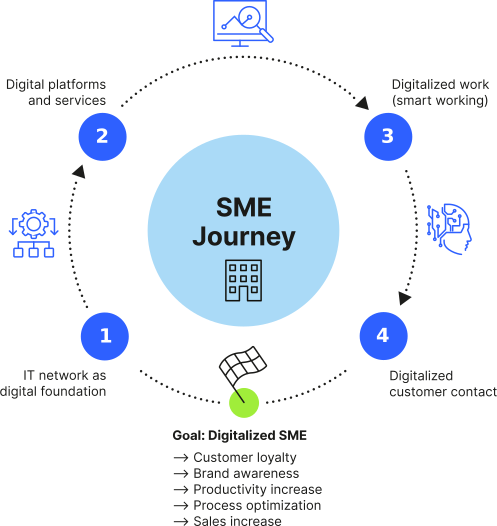
The digitalization of medium-sized businesses is not a one-time project but a continuous process. Especially in traditionally structured SMEs that have evolved over many years, the goal is not to implement everything immediately, but to further develop digital transformation in a structured way that matches individual requirements.
A secure IT network forms the foundation for:
- Reliable business processes
- Greater information security
- Secure cloud and site connectivity
- More efficient collaboration and modern work models (smart working)
- Greater flexibility, agility, and resilience in everyday business
- Sustainable growth and new competitive advantages
Why IT security requires action now
Today, cyberattacks rarely target only large corporations. SMEs are often especially attractive targets because their networks have grown historically, security measures may be lacking, or IT teams are heavily burdened in daily operations. Particularly critical are insecure remote access, missing network segmentation, outdated systems, lack of network transparency, and missing security policies. The consequences are obvious:
- 87% of German companies are affected by data theft, espionage, or sabotage.
- Cybercrime causes €289 billion in damages annually to German businesses.
- Only every second company has an emergency plan for cyberattacks.
- NIS2 affects significantly more companies than previous critical infrastructure regulations.
Sources (German): Bitkom study „Wirtschaftsschutz 2025“ & press release | IHK / BSI informationen on NIS2 directive


Since its founding in 2002, our company has not only had to face the challenges of digital transformation itself, but above all has accompanied numerous other medium-sized companies in their digitalization in a spirit of partnership and trust.
We know first-hand how complex this task is and that it has to be solved individually. Get to know a partner who is in the same boat, in the same time zone, and in the same jurisdiction area! Together we will digitalize your company in a way that suits your purposes. We look forward to hearing your story and sharing ours with you.

“Information security must take on a significantly higher priority and become the foundation of all digitalization projects."
Translated from German. Original quote by the Bundesamt für Sicherheit in der Informationstechnik (BSI).

Identify
The first step is to thoroughly examine your company network for vulnerabilities and identify potential security risks at an early stage. Only companies that create transparency regarding their IT infrastructure can specifically address critical weaknesses and clearly define the most important areas for action. Regular analysis forms the basis of a resilient security strategy.

Inform
Based on this, information security should become firmly established within the company. This includes building expertise as well as continuously raising awareness and training all employees. Informed teams can recognize risks more quickly in daily operations, consistently implement security policies, and avoid human errors – one of the most common causes of cyber incidents.

Intervene
Once the foundations are in place, the implementation of concrete security measures and clear policies follows. Modern security concepts help ward off threats early and sustainably protect companies against business-critical cyberattacks and IT failures. A current security standard creates the basis for secure, stable, and future-oriented digitalization.
Secure SME networks explained simply
Modern enterprise networks today must provide much more than pure connectivity. SMEs do not need complicated visions of the future, but solutions that work securely in everyday operations and with growing data volumes, modern applications, and mobile working – without making administration, data protection, and IT security overly complex. But what does this specifically mean for networks in small and medium-sized enterprises (SMEs)?

How centralized cloud management relieves SME IT teams
Cloud network management should be part of every SME network.
It helps centrally, efficiently, and much more easily manage distributed locations, new devices, and growing security requirements. Security incidents can therefore be detected early while simultaneously reducing the effort required for configuration, monitoring, and maintenance – especially when IT resources are limited.
Our expert explains in the video how cloud management specifically benefits everyday operations – from automated workflows and fewer on-site deployments to Wi-Fi optimization. Because that is exactly what matters for SMEs: simplifying processes, relieving IT teams, and remaining capable of acting at all times. Direct link to the video (German only)
For a secure, digitally sovereign SME sector
No company is too small to prioritize its own cybersecurity and digital sovereignty. In fact, the NIS2 directive will soon make this a legal requirement. Companies with as few as 50 employees or an annual turnover of 10 million euros will be affected in the defined critical infrastructure sectors. Failure to comply will become costly and problematic since October 2024. Check now to see if your company falls under the directive and what requirements you need to meet:
Smart food service
For many companies, smart working is already part of their processes. In the restaurant industry, for example, time is a critical factor, and digitalization requires a well-organized and secure network. The startup Aitme GmbH, for instance, needed secure and reliable remote management via the cloud and virtual hardware for its innovative cooking robots:

Intelligent manufacturing
Monotonous, repetitive tasks such as assembly line production offer enormous automation and standardization potential for SMEs. PackEx GmbH therefore relies on highly digitalized packaging production and has modernized its network infrastructure with comprehensive Wi-Fi and cloud management to ensure future readiness.

Smart hospitality and restaurant management
Yes, even relaxation requires the right digital infrastructure so that background processes run smoothly and, above all, automatically. Guest Wi-Fi, reliable point-of-sale systems, unobtrusive security measures, or the stable control of measurement and control technology—a wellness resort like the AVITA in Bad Tatzmannsdorf highlights several network requirements:

Which IT security measures should medium-sized companies implement first?
Medium-sized companies should first gain transparency over their network, devices, user access and critical applications. Based on this, secure remote access, strong authentication, up-to-date firewalls, regular updates, network segmentation and clear security policies are particularly important. The key is to start with the greatest risks and gradually expand IT security in a way that fits the company.
How can SMEs securely connect home office users, field staff, and external service providers?
SMEs should always encrypt external access, authenticate users clearly and restrict access to the applications that are actually required. Proven measures include VPN connections, multi-factor authentication, role-based access rights, and central security policies. This allows secure access to company resources without unnecessarily exposing internal systems.
Why is network segmentation so important for medium-sized companies?
Network segmentation separates areas such as administration, production, guest Wi-Fi, IoT devices, and critical systems from one another. This helps contain security incidents, because attacks or misconfigurations cannot spread freely across the entire corporate network. For historically grown IT infrastructures, segmentation reduces ransomware risks, downtime, and unauthorized access.