5G is the fifth generation of mobile communications and today provides the foundation for high-performance mobile broadband access, resilient site connectivity, and, increasingly, industrial applications. With 5G New Radio (NR), the standard supports high data rates, low latency, and a high device density. However, the performance actually achieved depends on factors such as frequency, network architecture, radio coverage, network load, and the end device.
Learn more about how to efficiently deploy 5G in your enterprise network in the Whitepaper: 5G – Mobile communications in enterprise networks.
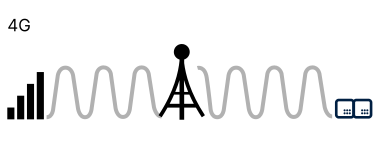
In cellular radio, high-frequency electromagnetic waves transport data packets from the antennas or radio cells to the receivers. The frequency describes the number of these waves per second. The bandwidth, on the other hand, provides information about the available interval width within a frequency spectrum.
The lower the frequency, the greater the range or cell size that can be achieved. However, data throughput is highly limited in this lower frequency band due to the small number of free channel bandwidths. Such a network is therefore suitable for coverage in extensive areas with lower data throughput requirements.
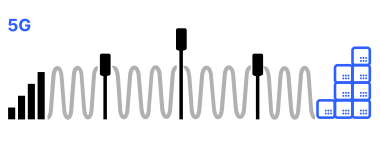
The opposite is true for networks that cater to a high user density: By using higher frequencies, larger channel bandwidths are available, enabling faster transmission of large amounts of data and thus improving performance. In addition to large mobile communications antennas, small cells are also used as base stations to compensate for the shorter radio wave range. The higher frequencies reserved exclusively for 5G are therefore mainly suitable for operation in cities and other conurbations.
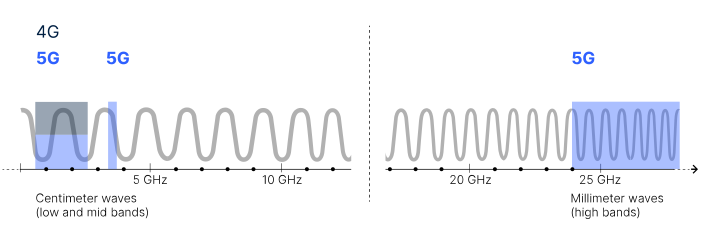
Wider frequency ranges
5G New Radio (NR) uses a broad frequency spectrum to meet different requirements for coverage, capacity, and data rates. A fundamental distinction is made between Frequency Range 1 (FR1) and Frequency Range 2 (FR2).
FR1 covers low- and mid-band frequencies. Due to their propagation characteristics, lower…
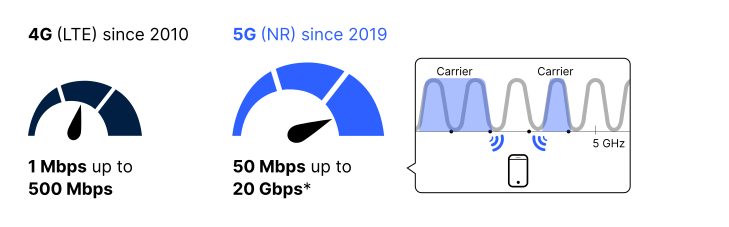
Higher speeds
In contrast to previous standards, the increased bandwidth efficiency of 5G enables significantly faster uploads and downloads at theoretically double-digit Gigabit speeds*. Compared from 4G (LTE) to 5G, much faster loading times can be achieved in any case. Frequency or channel bundling, which is also used for LTE-A ("Advanced"), ensures the use of a larger…
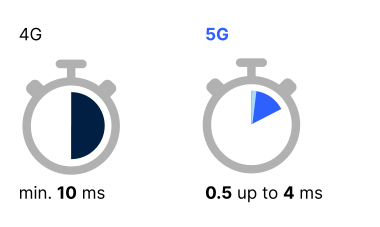
Lower latencies
5G enables shorter response times than previous generations of mobile communications. However, particularly low latency depends on the entire end-to-end architecture – from the radio interface and transport and core networks through to the respective application. 5G Standalone and locally deployed edge infrastructures can help further shorten communication paths.
More stable capacity
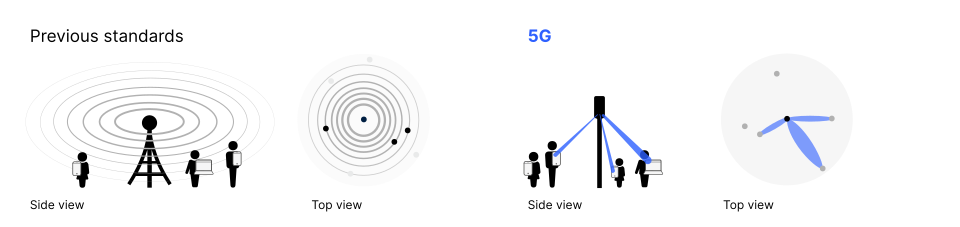
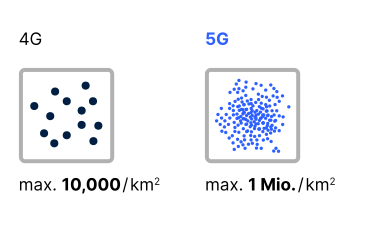
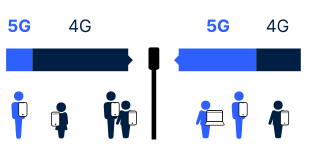
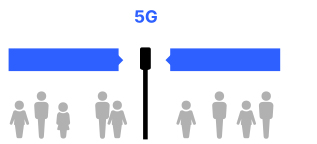
High-performance 5G cells can simultaneously serve more mobile receivers more precisely and faster than 4G antennas despite shorter range. The so-called small cells further condense existing antenna sites when demand is particularly high, in order to increase network capacity and reliably prevent network congestion at major events or in train…
From 5G NSA to 5G Standalone
When the first 5G networks were deployed, 5G Non-Standalone (NSA) was predominantly used. In this architecture, 5G New Radio (NR) is integrated into an existing LTE network architecture. LTE handles key signaling and connectivity functions, while 5G NR provides additional radio capacity for data transmission. This approach enabled a rapid 5G…
From 5G to 5G-Advanced and RedCap
5G is continuously evolving through successive 3GPP releases. 3GPP Release 18 marks the beginning of 5G-Advanced and expands existing 5G radio and network capabilities in areas including efficiency, MIMO, positioning, and the integration of AI/ML and Non-Terrestrial Networks (NTN). This optimizes 5G for an increasingly broad range of…
How secure is 5G?
Compared with previous generations of mobile communications, 5G provides enhanced security mechanisms for authentication, subscriber identity, and communication. For enterprise applications, however, securing the mobile network alone is not sufficient. 5G should therefore be integrated into the existing security architecture – for example, using VPNs and encryption, firewalls, segmentation, access control, and centralized monitoring. Particularly in Private 5G environments, the radio network, 5G Core, edge infrastructure, and enterprise network should be considered and secured as a whole.
5G use cases
5G provides enterprises with a flexible and high-performance addition to their existing network infrastructure. Use cases range from resilient site connectivity and temporary access to private 5G networks for campus and industrial environments.
Backup and resilience
As an additional WAN connection, 5G can provide reliable backup for wired internet connections. If the primary connection fails, traffic can automatically be routed via the mobile network. By providing an independent transmission path, 5G increases site availability and reduces the risk of prolonged downtime.
Primary access and Multi-WAN
Thanks to high data rates and low latency, 5G can also be used as a primary WAN connection in suitable scenarios – for example, at sites without high-performance fixed-line connectivity. In Multi-WAN and active/active scenarios, fixed-line and 5G connections can also be used in parallel, with data traffic intelligently routed according to availability, connection quality, or application requirements.
Day-1 connectivity and temporary sites
5G enables new or temporary sites to be connected quickly without having to wait for a wired connection to be provisioned. Typical use cases include new branch offices, construction sites, pop-up stores, and mobile locations. eSIM can further simplify deployment: mobile network…
Private 5G for campus and industrial environments
With Private 5G, enterprises can operate their own non-public mobile network for campus and industrial environments. Radio coverage, subscribers, and network resources can be tailored specifically to individual requirements. Typical applications include AGVs (Automated Guided…
Learn more about how to efficiently deploy 5G in your enterprise network in the Whitepaper: 5G – Mobile communications in enterprise networks.
Our R&S®LANCOM Secure SD-WAN gateways with 5G support both 5G Non-Standalone (NSA) and 5G Standalone (SA) operation, making them suitable for modern 5G network architectures.
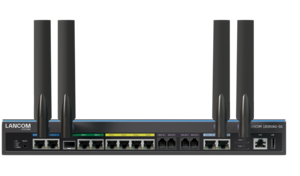
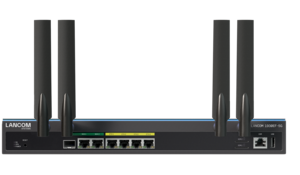
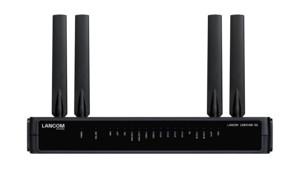
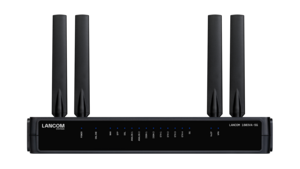
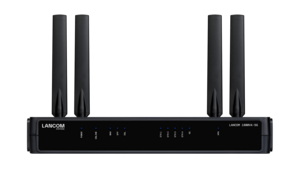
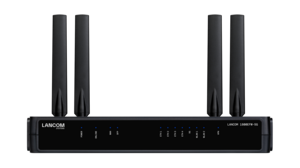
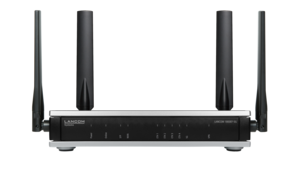
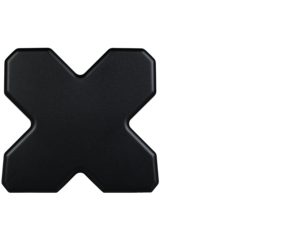
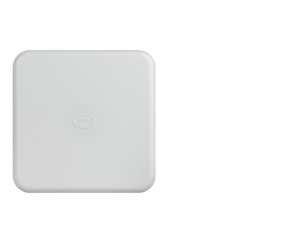
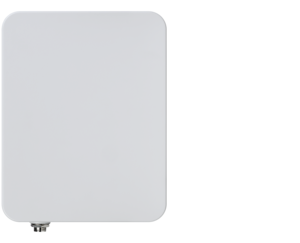
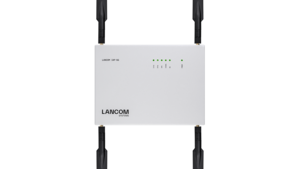
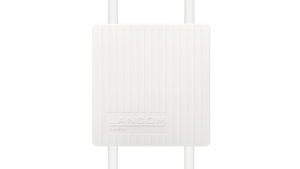
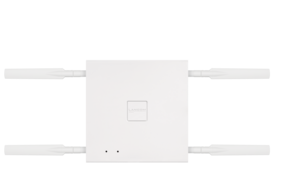
| Product Name | Product Info | ||
|---|---|---|---|
|
R&S®LANCOM 1936VAG-5G |
Secure SD-WAN VoIP gateway with multi-WAN over VDSL or G.fast, fiber, Gigabit Ethernet, and 5G (dual-SIM/eSIM) for secure networking of mid-sized or large enterprises |
More information |
|
R&S®LANCOM 1930EF-5G |
Secure SD-WAN gateway with multi-WAN over fiber, Gigabit Ethernet, and 5G (dual-SIM/eSIM) for secure networking of mid-sized or large enterprises |
More information |
|
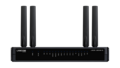
R&S®LANCOM 1803VAW-5G |
Secure SD-WAN VoIP gateway with VDSL, fiber, Gigabit Ethernet, Wi-Fi 6, and 5G (eSIM) for secure site networking of small and mid-sized enterprises |
More information |
|
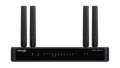
R&S®LANCOM 1803VA-5G |
Secure SD-WAN VoIP gateway with VDSL, fiber, Gigabit Ethernet, and 5G for secure site networking of small and mid-sized enterprises |
More information |
|
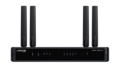
R&S®LANCOM 1800VA-5G |
Secure SD-WAN gateway with VDSL, fiber, Gigabit Ethernet, and 5G for secure site networking of small and mid-sized enterprises |
More information |
|
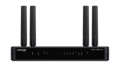
R&S®LANCOM 1800EFW-5G |
Secure SD-WAN gateway with fiber, Gigabit Ethernet, Wi-Fi 6, and 5G (eSIM) for secure site networking of small and mid-sized enterprises |
More information |
|
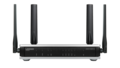
R&S®LANCOM 1800EF-5G |
Secure SD-WAN gateway with fiber, Gigabit Ethernet, and 5G for secure site networking of small and mid-sized enterprises |
More information |

|
R&S®AirLancer I-360D-5G |
Indoor 4G/5G antenna with 360° beam angle and 2x2 MIMO |
More information |
|
R&S®AirLancer O-360D-5G |
Outdoor 4G/5G antenna with 360° beam angle and 2x2 MIMO |
More information |

|
R&S®AirLancer O-360Q-5G |
Outdoor 5G antenna with 360° beam angle and 4x4 MIMO |
More information |
|
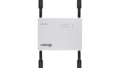
R&S®LANCOM IAP-5G |
Robust Secure SD-WAN gateway with 5G in an IP50-rated housing for secure site networking in demanding environments |
More information |

|
R&S®LANCOM OAP-5G |
Outdoor Secure SD-WAN gateway with 5G (eSIM) in an IP67-rated housing for secure site networking in demanding environments |
More information |

|
R&S®LANCOM 750-5G |
Cellular network extension with integrated 5G module for use as a modem or router |
More information |