Digitally sovereign IT in the healthcare sector
Smooth communication and information security are vital in the healthcare sector – both offline and online. Government directives such as the European NIS2 directive particularly focus, promote, and protect the latter. After all, digital healthcare has many advantages for all market participants, but must never come at the expense of data security.
A trustworthy IT infrastructure is the basic prerequisite for any form of digital networking in the healthcare sector. This is the only way to use the valuable synergy effects of digitalization securely and to avid potential liability risks for healthcare providers.
As a European solution provider, R&S Networks and Cybersecurity offers secure IT for the healthcare sector – engineered in Germany – enabling better quality of care while fully complying with legal security requirements.
Quick overview of the R&S Networks and Cybersecurity (formerly LANCOM) Healthcare solutions:
R&S Networks and Cybersecurity Healthcare Brochure
R&S Networks and Cybersecurity Connected Health Ecosystem Flyer
R&S Networks and Cybersecurity Health IT Infrastructures Flyer
R&S Networks and Cybersecurity Health IT Solutions Matchmaker

Secure digitalization in the healthcare sector
Digital networking in the healthcare sector offers transformative opportunities through eHealth and digital health, enabling the optimal use of resources, standardized processes, and synergy effects. To fully harness these advantages, a secure and legally compliant IT infrastructure is essential. It provides the foundation for seamless collaboration between practices, clinics, care services, and therapists.
With R&S Networks and Cybersecurity, healthcare providers gain access to innovative solutions that integrate modern patient care with the highest standards of data protection..
Invest now in Digital Sovereignty and NIS2 preparations
The healthcare sector has been part of the critical infrastructure sectors affected by the NIS1 directive since 2016 and is subject to certain European cybersecurity requirements. With NIS2, further, stricter requirements will now be added from October 2024, which will be laid down in national laws. Compliance will be checked and sanctioned. It's best to prepare now and find out what you need to consider in the future – also in the interests of your Digital Sovereignty:
Find out now about NIS2 and the topic of “Digital Sovereignty”!
Digital health: the political course has been set
The exchange of medical data in care clusters should make healthcare more accessible, more effective and cheaper. Diagnostics, therapy, and research can also be made more efficient and at the same time more individualized in a digital network.
A desirable side effect is that the patient becomes the focus of attention. Targeted information exchange, smooth communication and close support along the "digital patient pathway" or "digital care pathway" will significantly improve the quality of care.

Laws and guidelines for the protection of health data
The advancing digitalization of the healthcare sector is increasing the cyber risk for medical and research institutions. Accordingly, increasingly strict national and European laws regulate the protection of sensitive patient data and critical medical systems.
National guidelines
National laws on digitalization and IT security in the healthcare sector describe very clearly where healthcare should be heading in the future:
Away from rural and demographic undersupply, towards a digitally networked healthcare landscape with a broad range of medical services (ehealth / digital health). And as soon as possible. Some European countries are far ahead in this respect, while others are driving development forward with laws and subsidies.
Patient data protection and NIS2
The General Data Protection Regulation (GDPR) describes guidelines for the protection of electronic personal (patient) data.
Many healthcare facilities are also part of the critical infrastructure. The European Network and Information Security Directive NIS2 will apply to them from October 2024.
This is currently being transposed into national law and requires information and network security measures. Non-compliance is punishable by fines in the millions – whereby the owners and managers of practices, medical centers, and clinics are liable with their private assets.
Rural healthcare provision with secure healthcare networks
Cross-sector care processes are a key factor in providing comprehensive healthcare to the population. Unfortunately, due to a shortage of doctors and the closure of surgeries and pharmacies, the density of care is becoming ever lower, particularly in rural areas.
Only regional healthcare centers and networks, in which doctors, pharmacies, nursing services, laboratories, and medical supply stores work together to treat patients, can counteract this development. In order to provide high-quality healthcare, it is essential to create a secure database on patients and uniformly used, trustworthy communication channels.
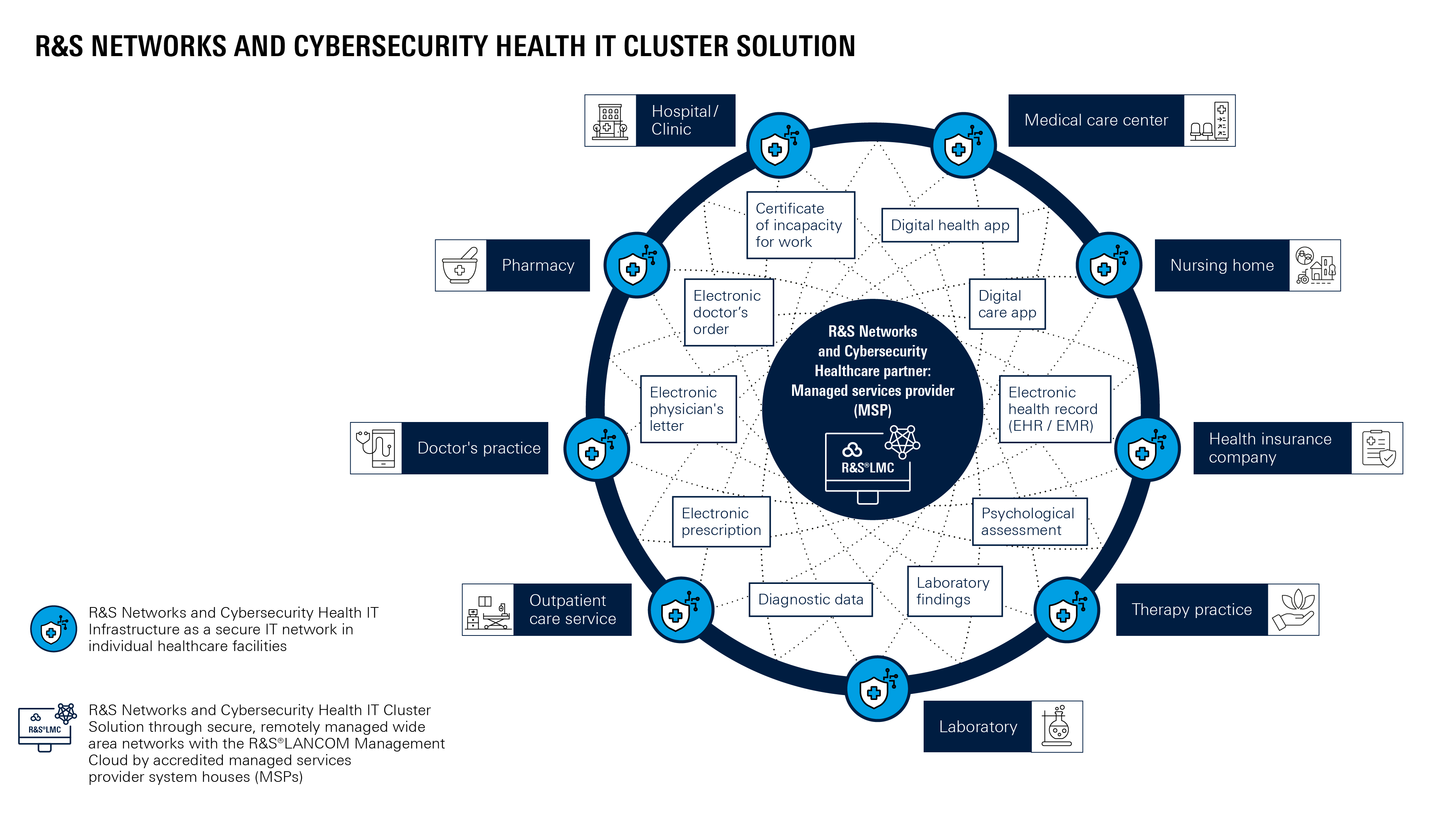
The R&S Networks and Cybersecurity Connected Health Ecosystem concept offers the healthcare market a digital ecosystem in which healthcare providers can equip themselves with the latest, secure network technology and join together in protected care clusters.
R&S Networks and Cybersecurity Connected Health Ecosystem
The basis for digital ecosystems and symbioses in the healthcare market
The basis for the legally compliant and efficient exchange of information within the healthcare market is a closed digital network in which the healthcare facilities involved can securely generate and exchange highly sensitive patient care information.
The R&S Networks and Cybersecurity Connected Health Ecosystem offers the best conditions for this: It equips the respective facilities with R&S Networks and Cybersecurity Health IT Infrastructures and is then expanded into an overarching care cluster via a R&S Networks and Cybersecurity Health IT Cluster Solution with the help of a cloud-managed, digital healthcare network.
With the symbiosis of health IT infrastructure and cluster solution, multiple data connections can be established between practices, clinics, laboratories, and therapists. In addition, larger facilities in particular can provide healthcare professionals in the home office with decentralized access via the R&S®LANCOM Advanced VPN Client for telemedical care of patients.
The R&S Networks and Cybersecurity Health IT Cluster Solutions can be expanded as required. This means you can gradually expand your network and the range of services. The care network is installed and monitored by specialized and trained system houses.
R&S Networks and Cybersecurity Healthcare Brochure
R&S Networks and Cybersecurity Healthcare Reference Projects
R&S Networks and Cybersecurity Health IT solutions
Cybersecurity and digital networking for optimal healthcare
With the R&S Networks and Cybersecurity Health IT Infrastructures, all network components (hardware and software as well as service/support) necessary in the healthcare institutions can be purchased, leased, or rented for three years.
The Health IT Cluster Solutions ultimately network the healthcare institutions in a digital ecosystem for joint cooperation, which is managed by managed services providers. In this way, overarching collaborative and referral networks can also be implemented securely.
The benefits for healthcare institutions:
- Compliance with the legal requirements of government directives like the NIS-2 directive
- Secure use of telemedicine within medical and healthcare networks
- State-of-the-art cybersecurity
- Flexibility: purchase or lease / rent at monthly or quarterly usage fees
- Efficient resource usage thanks to support from industry-experienced technology partners
The convenient all-in-one solution can be scaled to the needs of the healthcare facility at any time.
Secure healthcare networks: good for everyone
Cooperation along the medical and nursing care pathway brings concrete benefits for institutions and patients. Here are some examples:
How can patient data be exchanged securely in connected healthcare networks?
Patient data should only be exchanged via protected and clearly defined communication channels between authorized healthcare institutions. This requires encrypted connections, secure access rights, up-to-date network security, and transparent management of the systems involved. This enables practices, hospitals, laboratories, pharmacies, care facilities, and therapists to collaborate digitally without compromising sensitive health data.
Why are managed services useful for healthcare IT infrastructures?
Managed services relieve healthcare institutions by allowing specialized IT partners to handle the planning, operation, monitoring and maintenance of the network infrastructure. This is particularly useful when medical practices, healthcare centers, hospitals or care facilities need to meet high security requirements but have limited internal IT resources. At the same time, networks can be operated in a scalable way and expanded with additional locations or digital healthcare services when needed.
How can healthcare institutions prepare for NIS2 and new IT security requirements?
Healthcare institutions should first identify which systems, data and processes are particularly critical for patient care. They should then assess their existing security measures, including networks, access rights, firewalls, updates, backups and monitoring. Based on this assessment, technical and organizational measures can be prioritized to better protect patient data, avoid outages and implement regulatory requirements step by step.