Maximum availability, security, and scalability for retail networks
In modern retail, every touchpoint must function: checkout, Wi-Fi, inventory management, digital services, price updates, and location connectivity. At the same time, customers expect a seamless shopping experience, store teams expect simple processes, and headquarters expects full control over security, rollouts, and operating costs. This is exactly where SD-Branch comes in: as a secure, scalable, and centrally manageable infrastructure for distributed retail locations.




Brick-and-mortar retail remains strong thanks to immediate availability, personal advice, and the physical product experience. However, it only reaches its full potential today when these advantages are combined with digital components: such as reliable internet connectivity, comprehensive Wi-Fi coverage, omnichannel capabilities, electronic price tags, self-checkout, mobile payment services, retail analytics, click-and-collect processes, or digital advertising spaces. This transforms the store into a Connected Retail experience.
For retailers, this means that customer experience and operational stability are not mutually exclusive. They are built on the same foundation – a high-performance network that reliably connects stores, systems, devices, and applications. Investing in this infrastructure lays the groundwork for customer loyalty, more efficient operations, higher sales, and better control over running costs.
Glossary of retail trends 2026 / 2027
Our glossary explains the current concepts, terms, and innovations in retail and what they entail exactly Retail Trend Terms 2026
White paper Intelligent digital retail networking
What you can expect:
- The four key principles for future-ready retail IT infrastructures
- Best-practice network scenarios for branches, franchises, and shop-in-shop systems
- Seven steps to smart retail and their significance for the IT network


Highly available payment systems
The most critical moment in the store is the payment process. POS systems and terminals must function flawlessly at all times and be designed with redundancy. If something fails here, it affects not only a single process but the entire shopping experience. Modern payment infrastructures therefore require prioritized POS traffic, secure network segmentation, and redundant WAN connections with LTE/5G fallback to ensure that checkout processes remain stable even in the event of disruptions.

Secure and Stable Connectivity
Today’s retail sector needs far more than just internet access. Stable connections are required for POS systems, inventory management, Wi-Fi, handheld devices, video, digital services, and communication with headquarters. These systems must be continuously available and properly secured. POS systems, scanners, ESL, sensors, cameras, mobile devices, and customer Wi-Fi place high demands on bandwidth, stability, and segmentation, which can be met through Wi-Fi 7, switching redundancies, fallback internet lines, and VLANs, among other solutions.
Centralized control instead of on-site effort
The more locations that are operated, the more important it becomes to have a model that allows rollouts, changes, and security policies to be managed centrally. New services, price changes, and network adjustments must be able to be deployed quickly and consistently across all locations. Standardized network templates, zero-touch rollouts, and cloud-based management significantly reduce the workload for IT teams.

Predictable costs and future-proofing
Retail infrastructures must not only function today but also be equipped for new applications. At the same time, operators expect transparent operating costs, low IT complexity, and solutions that grow with the business model. Also worth considering: Retail networks should support new technologies such as Wi-Fi 7, IoT, or edge computing without having to completely replace existing infrastructures.
Retail stores
In traditional store structures, stores and headquarters expect one thing above all: stable systems without high on-site IT overhead and an optimal omnichannel experience. Headquarters wants to securely connect all locations to the merchandise management system, protect data, analyze it centrally, and roll out promotions or price changes everywhere in real time whenever possible. The store needs reliability, resilience, and an infrastructure that can also support future applications.

Designed once, rolled out a thousand times
An identical store setup is a major advantage for you as the IT manager responsible for networking a retail chain. The network design of a single store can be replicated exactly for all other stores. What you need is a network infrastructure that adapts flexibly to your requirements while still maintaining consistent user experience. This is where Rohde & Schwarz Networks and Cybersecurity comes in as your partner.
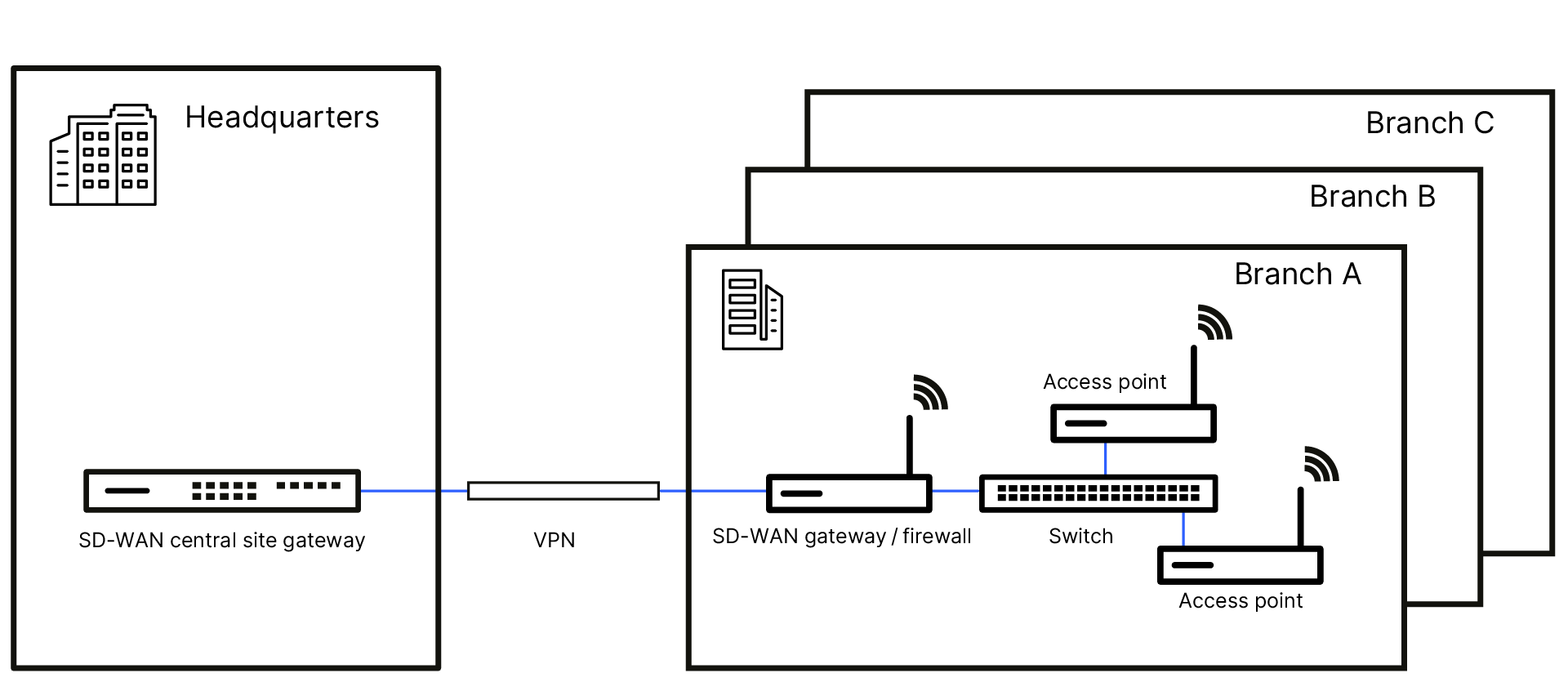
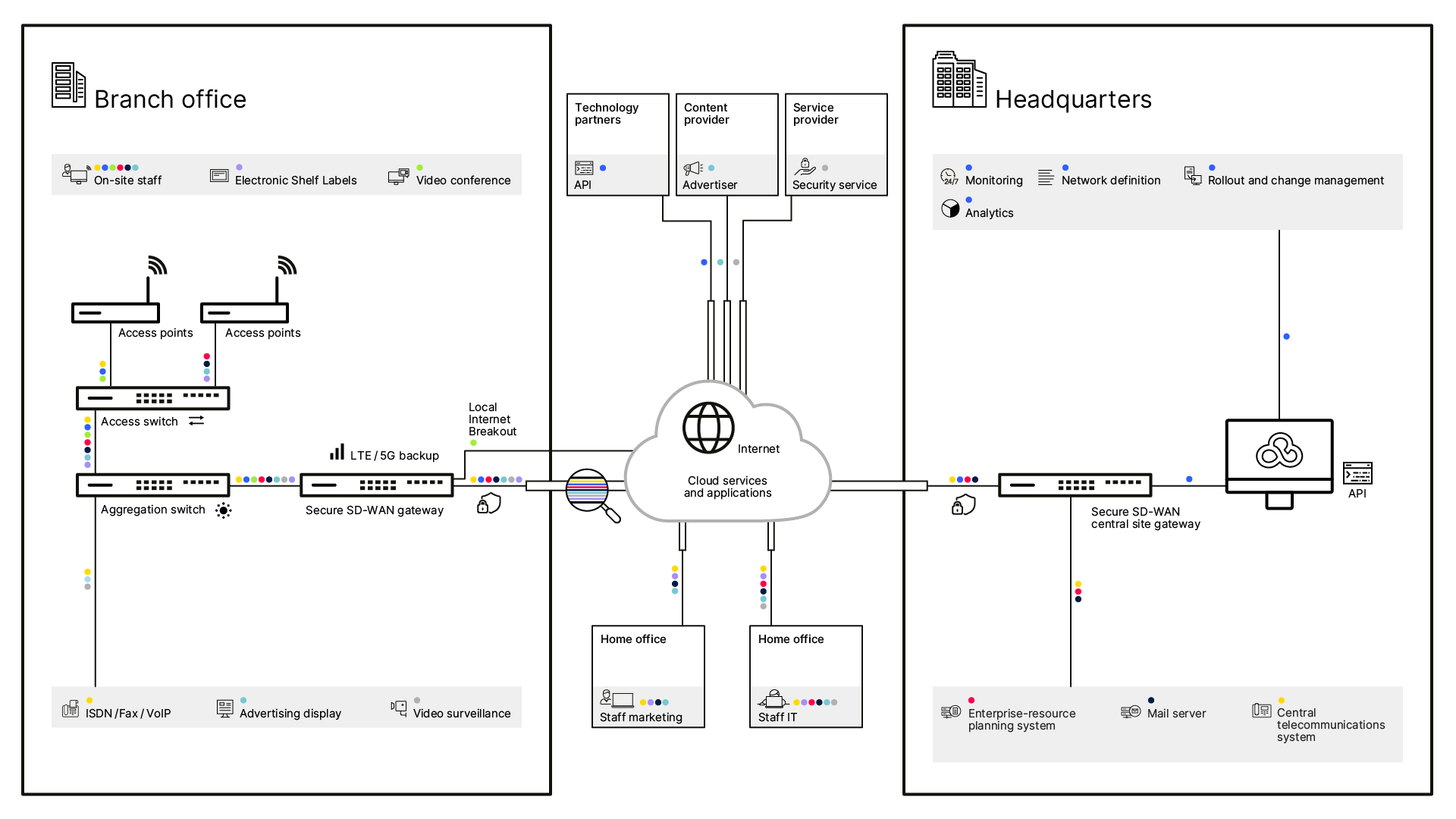
You do not need a lot of hardware to set up a functional branch network. For small branches with few digital applications—such as a gas station – a router with optional Wi-Fi may be all you need. In larger retail branches with many requirements and end users, you are already well-equipped with a router or Secure SD-WAN gateway, a switch, and a number of access points tailored to the premises. The individual branches, regardless of their size, are connected to headquarters via a secure VPN – and your branch network is ready to go.
Franchise
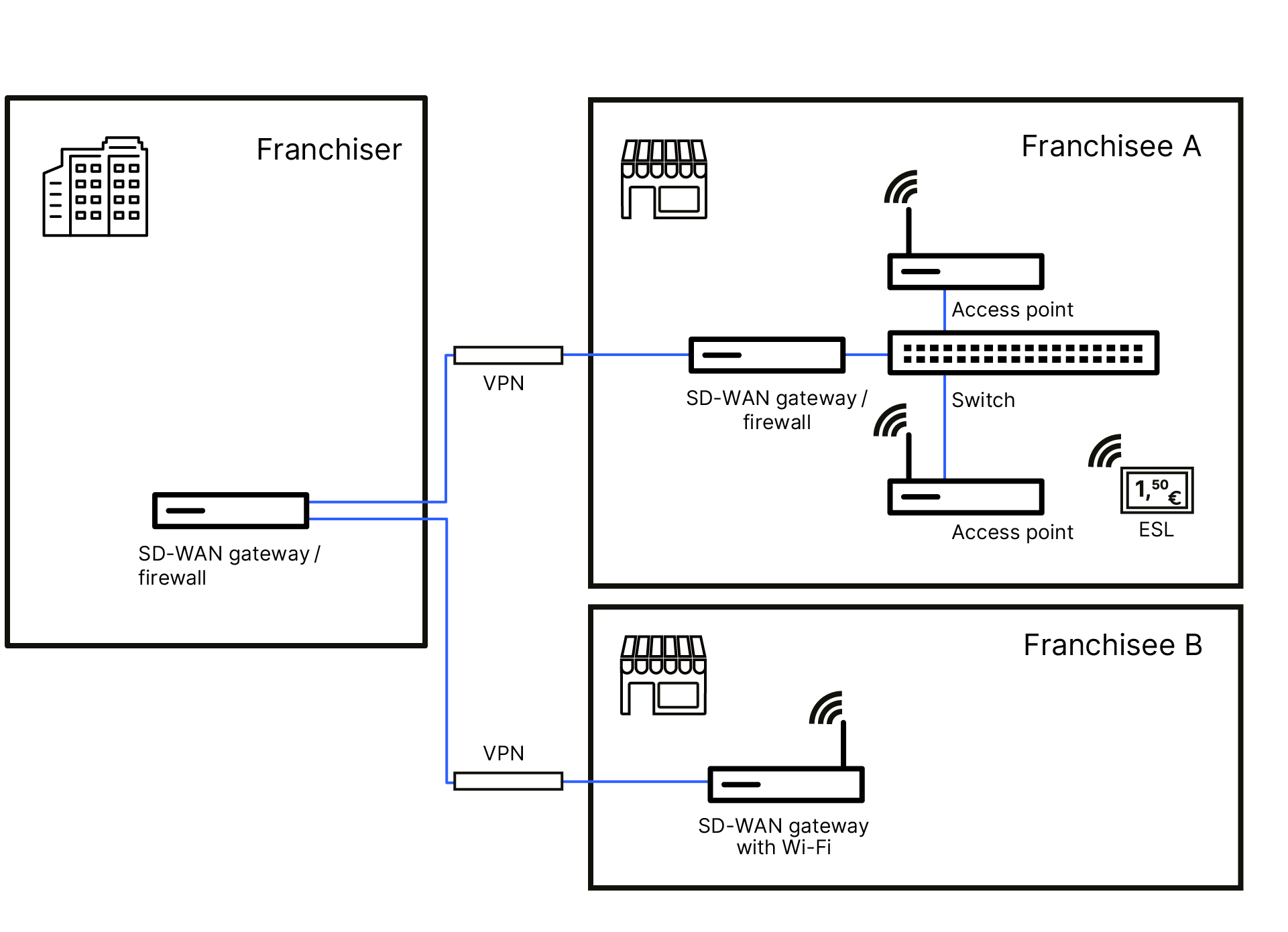
In a franchise, central standards and local flexibility must go hand in hand. Franchisors expect consistent implementation of their concept, centralized data connectivity, and the simultaneous rollout of new services. Franchisees primarily expect multi-tenancy, functioning point-of-sale systems, access to centralized systems, low TCO, minimal maintenance, and enough flexibility for their store space and local business.

For predictable scalability
You define once which equipment is needed and then deploy the same combination of devices in every store.
- A Secure SD-WAN gateway (router or firewall) for internet access and connection to the franchise headquarters or external service providers
- A branch switch for networking all network components at the franchise location
- Depending on the size of the branch, three or more Wi-Fi access points for your Wi-Fi applications
- A network management solution with a high degree of automation and excellent clarity
Shop-in-Shop
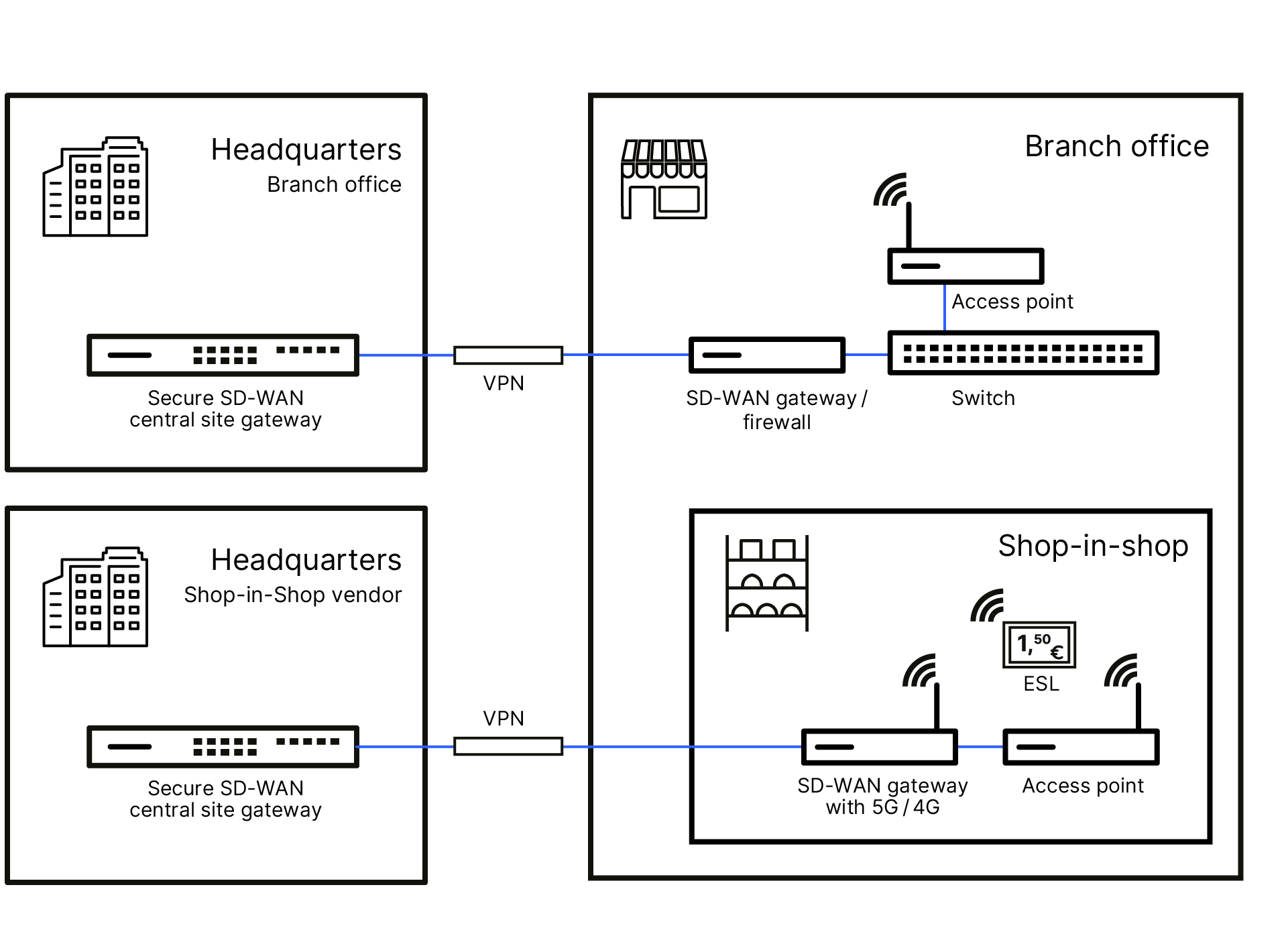
Shop-in-shop concepts require reliable, streamlined, and easily controllable networking in third-party locations. A stable connection to headquarters, automated data exchange, and the ability to centrally control prices and content in near real-time are crucial. This is precisely where secure network segmentation using VLANs, VPN, and optional 4G/5G pays off for conflict-free operation.

Achieving success with the shop-in-shop concept
The goal, therefore, is to maintain the landlord’s secure network isolation and performance while ensuring a smooth, high-speed connection for the shop operator. The most conflict-free way to achieve this is with mobile routers that use 4G/LTE or 5G for the internet connection. They are quick to install, do not require complex integration into the retail space landlord’s infrastructure, and protect the autonomy and interests of both parties.
This allows both the store where the shop-in-shop is located and the shop-in-shop itself to be connected to their respective headquarters independently and with maximum performance. Secured by a VPN tunnel, the data flow remains constant and protected for both.
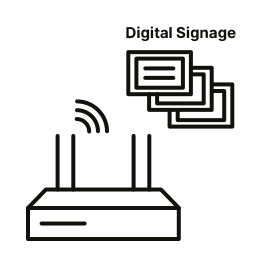
With R&S Networks and Cybersecurity Digital Signage access points, Wi-Fi and ESL radio traffic coexist at peak performance, ensuring smooth business operations in the shop-in-shop.
The wide range of applications for digital signage
Reaching and engaging customers quickly and directly at the point of sale, keeping staff up to date, and setting up processes in a dynamic and transparent manner. All of this is possible with Electronic Shelf Labelling (ESL) or digital displays. Electronic signage is not merely decorative or a ‘nice-to-have’ feature, but an integral part of a thoroughly thought-out wireless infrastructure in which all data is available at any time and in any location.


Access points with integrated wireless modules
Our ESL-capable access points not only deliver optimal Wi-Fi with many practical and innovative features but also seamlessly support digital displays. If you’re planning a new Wi-Fi infrastructure, these access points are the top choice: with Wi-Fi 7, they’re perfectly suited for applications in the Internet of Things (IoT) or Industrial Internet of Things (IIoT). Manufacturing facilities and logistics companies looking to digitize and optimize their processes can rely on the power of these access points. Digital displays from manufacturers VUSION and PDI digital are fully supported via an integrated interface.
Smart retail starts with the network
Future-proof network infrastructure
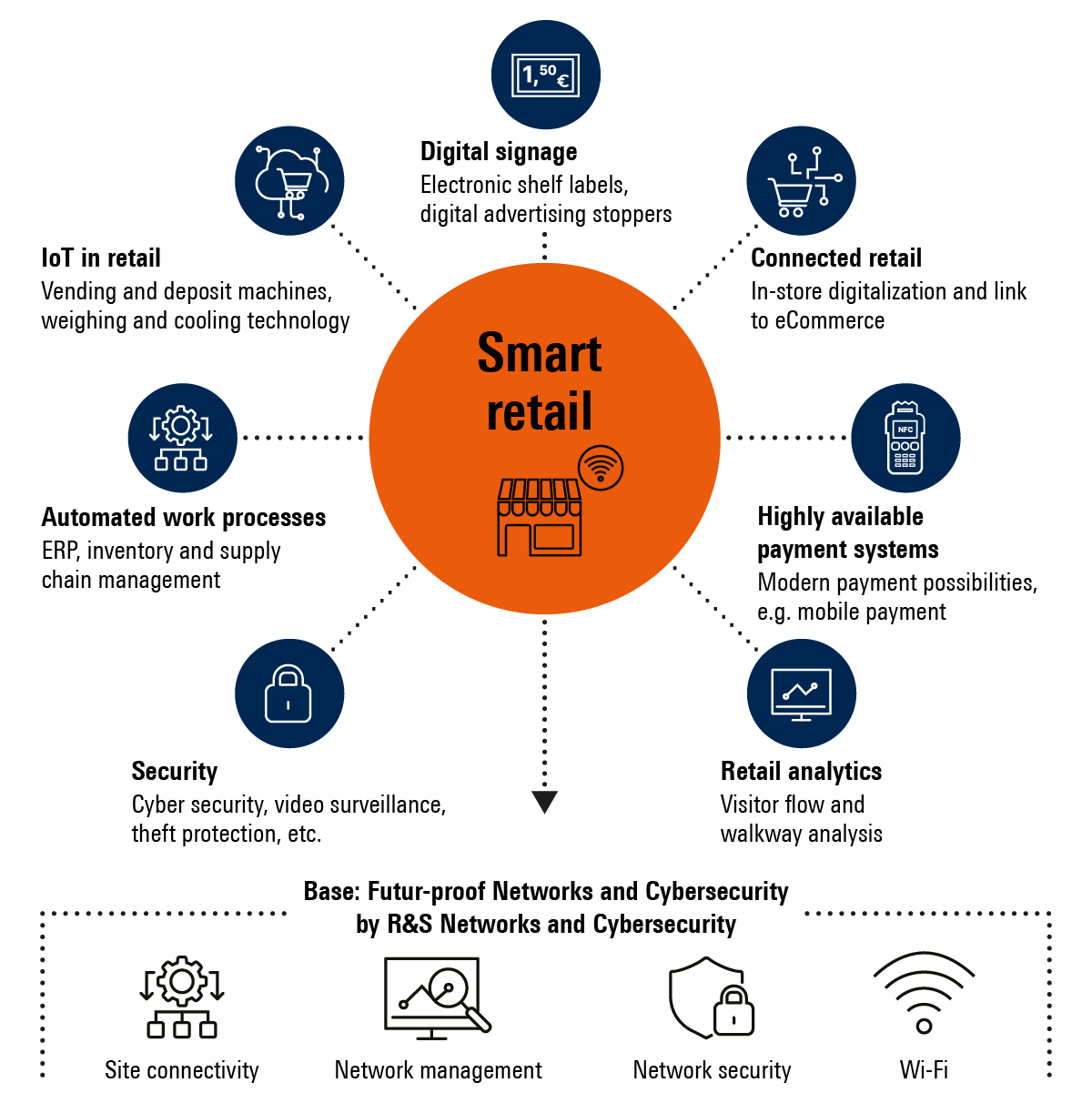
Whether digital price tags, omnichannel processes, promotional management, inventory information, or new in-store services: all these applications require a network that is secure, high-performance, and always available. Only when connectivity, Wi-Fi, segmentation, and location connectivity work together seamlessly does digitalization in retail become truly usable in everyday operations.
This is particularly true for omnichannel processes such as click-and-collect, real-time inventory, or in-store returns, where data must be continuously synchronized between the store, the merchandise management system, and digital platforms. At the same time, IoT devices, electronic price tags, self-checkout systems, and retail analytics place high demands on network performance, segmentation, and availability.
That is why retail IT should not consist of individual solutions operating in isolation. What is needed is an infrastructure that integrates WAN, LAN, Wi-Fi, and security into a unified operational framework. SD-Branch provides exactly this integration.
Why SD-Branch is the right solution
With SD-Branch, distributed retail environments can be operated securely and with minimal effort. New locations and devices can be rolled out quickly, applications receive protected access, and security as well as compliance policies can be implemented uniformly. This reduces complexity and makes growth manageable. Through centralized policies, automated rollouts, secure network segmentation, and SD-WAN, even complex branch structures can be efficiently operated and scaled.

Branch Networking
- Highly integrated portfolio for future-proof branch networking – without system silos
- Zero-touch WAN provisioning thanks to Auto-VPN and Auto-VLAN
- The entire SD-WAN architecture—including both on-premises devices and the central cloud orchestrator—is constantly kept up to date with software updates, including new features: To the R&S®LANCOM SD-WAN solution

Security
- “One-click Security” at all locations
- Industry-leading cybersecurity technology and Unified Threat Management with the R&S®PACE2 DPI Engine, sandboxing, and machine learning, antivirus, SSL inspection, and content filtering (including filters for maximum youth protection)
- Intuitive monitoring functions for maximum transparency and visibility of all devices and activities on your network

Scalability
- Maximum scalability thanks to centralized network and security orchestration for the entire infrastructure
- Centralized management & 24/7 monitoring without time-consuming and costly on-site technician visits
- Fast and secure provisioning of new services at all locations with a single click; trusted applications are prioritized

Trust
- Trusted cloud developed and hosted in Germany, or alternative hosting of a private cloud in the data center of your choice
- R&S Networks and Cybersecurity as a German manufacturer: full compliance with applicable European security directives and complete digital sovereignty
- GDPR-compliant handling of your data while adhering to the highest security standards
- Independent certificates from the Federal Office for Information Security confirm our security promise
Why R&S Networks and Cybersecurity?
R&S Networks and Cybersecurity combines the requirements of the retail sector with an infrastructure designed for distributed locations: secure, centrally controllable, and geared toward long-term operation. For retail, this means: less friction in day-to-day operations, better manageability of complex store networks, and a resilient foundation for connected retail.

Your benefits with R&S Networks and Cybersecurity:
- Secure site networking for stores, franchises, and shop-in-shops
- GDPR-compliant network architecture and European data sovereignty
- High scalability for hundreds of distributed locations
- Centralized management and provisioning via the R&S®LANCOM Management Cloud
- High availability for business-critical systems such as point-of-sale and terminals
- Fast, centralized rollouts of new locations, devices, and services with zero-touch provisioning
- Transparent, predictable operating costs
- Powerful foundation for ESL, digital signage, omnichannel, and other retail applications
- Long-term investment protection thanks to an upgradable infrastructure
What does SD-Branch mean in retail?
SD-Branch in retail refers to a centrally managed network infrastructure for distributed retail locations such as stores, franchises, and shop-in-shop spaces. It combines WAN, LAN, Wi-Fi, and security capabilities in a single, unified solution, enabling secure site connectivity, centralized management, automated deployments, and high availability for business-critical applications.
Why is SD-Branch important for stores, franchises, and shop-in-shop locations?
Retail locations require stable and secure connections for POS systems, inventory management, customer Wi-Fi, electronic shelf labels, payment processing, omnichannel workflows, and other digital services. SD-Branch reduces on-site IT effort, enables centralized security policies, and ensures that new locations, devices, and applications can be deployed quickly and consistently.
How does SD-Branch support highly available payment systems in retail?
SD-Branch can prioritize business-critical traffic such as POS and payment applications, securely segment networks, and protect connectivity through redundant internet connections. With LTE or 5G fallback, VPNs, centralized monitoring, and automated configuration, POS systems and payment terminals remain highly available whenever possible, even during disruptions.